
how deep does the rabbit hole go? (about 40 meters, actually)
Published:
Why is it so expensive to build transit in Toronto? The current cost of the Ontario line is estimated to be almost $30 billion, or nearly 2 billion dollars per kilometre. 1 In 2009, the capital cost of the Canada line was $2.1 billion. Not per kilometre, but for the entire 19km line with 16 stations and a dedicated operations and maintenance facility. 2 Even accounting for inflation and 30 years of operations and maintenance costs, the total cost of the Canada line would be something around $6-10 billion. The difference in price just doesn’t make sense. In four years, Vancouver built a 19km metro line with 16 stations for the same amount of money it takes Toronto to build 3km of subway. Why is that?
Is there just an unsolvable geographic problem in Toronto that requires $30 billion to fix? Almost certainly not. The original Yonge subway, roughly 7km between Union and Eglinton, cost just $789 million adjusted for inflation. 3 Transit costs being what they are is a uniquely North American current-day problem, not a geographic or historical certainty. Understanding transit costs requires understanding procurement structures and private sector incentives; the root of Ontario’s transit failures comes down to a lack of institutional accountability, a lack of internal engineering expertise, and a severe lack of political insulation.
Design makes, and design breaks
What makes a station a station? To construct a station, you need essentially two main elements: one, a platform, and two, a way to get people to that platform. However, the specific ways stations can be designed and built differ vastly. To understand why transit in Toronto is so expensive, perhaps the most important thing is to understand these two separate images:
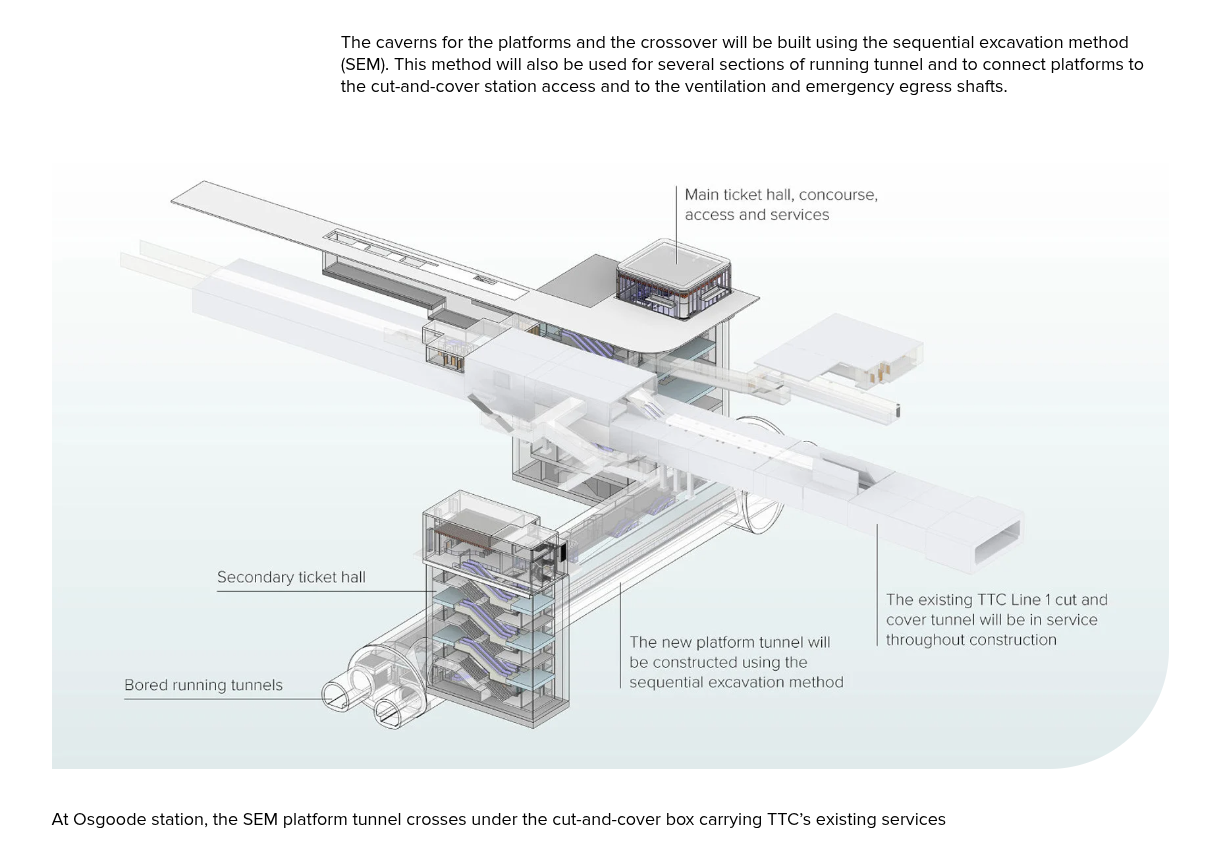
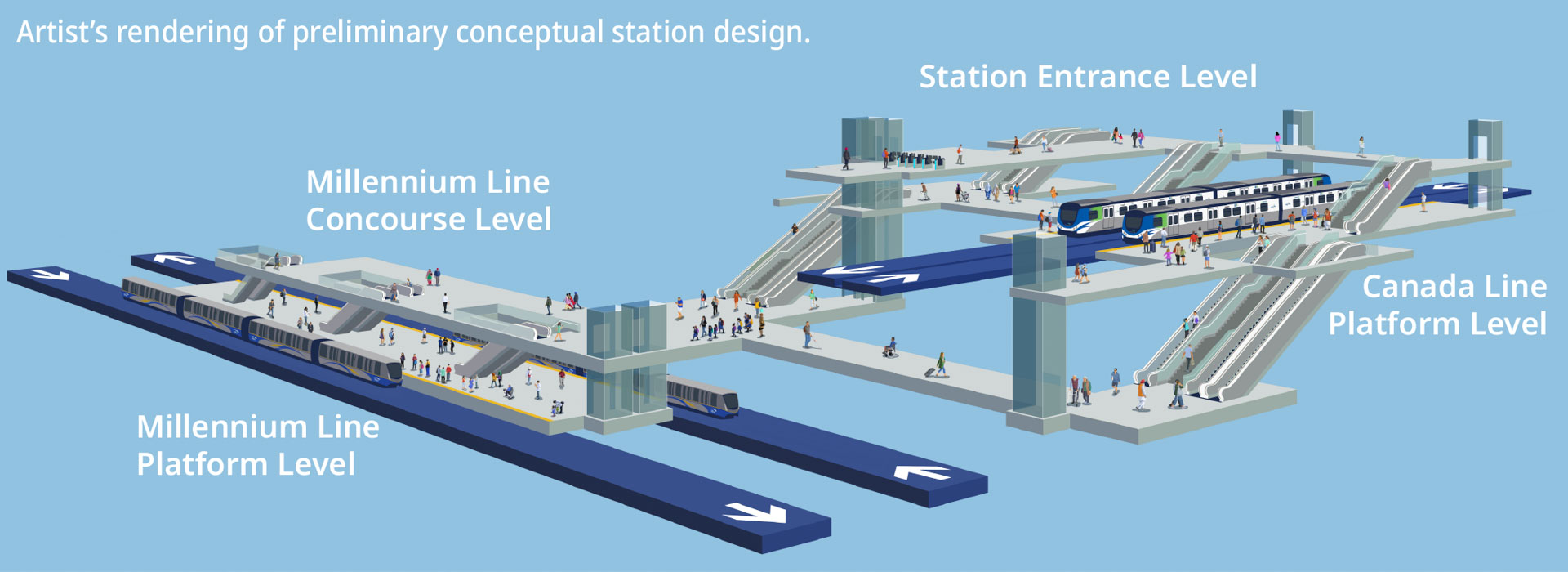
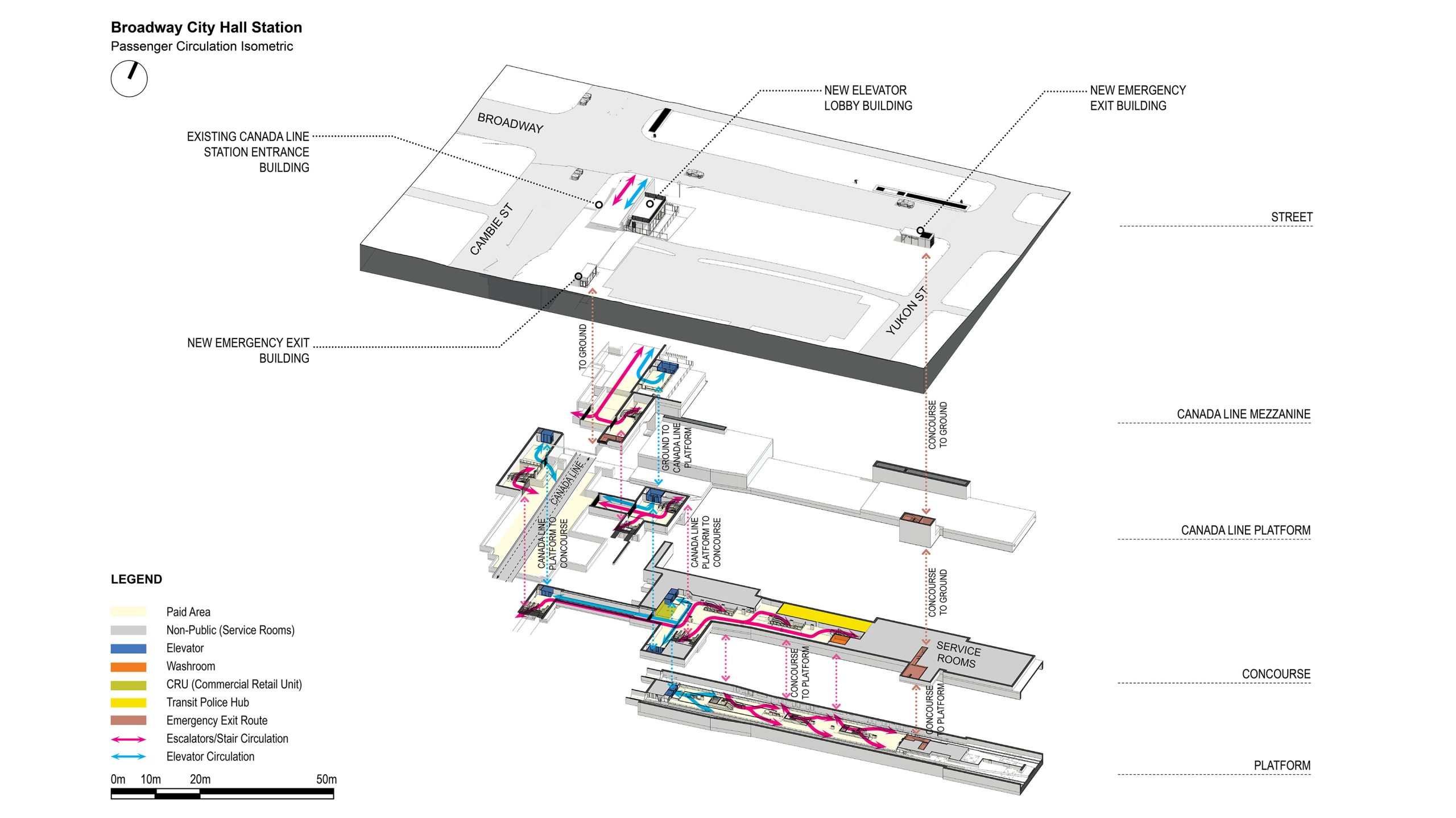
Both of these stations, Broadway-City Hall in Vancouver and Osgoode in Toronto, serve the same fundamental purpose; they exist as major interchange stations between an under-construction subway line and an existing subway station. In both cases, the new subway has to thread under the original older subway line while trains still operate above.
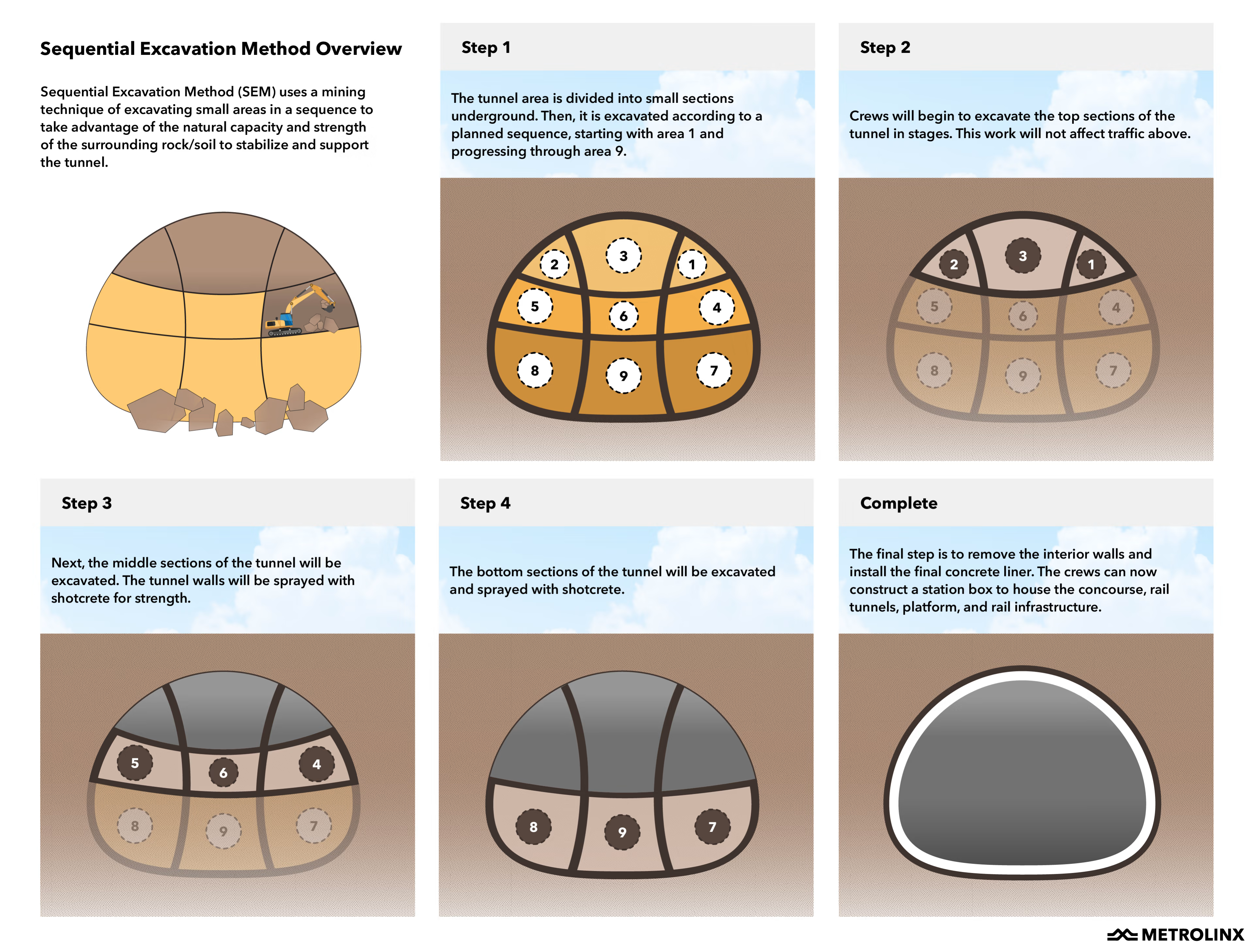
However, their design tells you something fundamentally different. Osgoode’s Ontario line platform is designed as a large, 40m deep, sequential excavation method (SEM) cavern that threads beneath the existing Line 1 platforms. The entire platform area is slowly excavated, meter by meter, while crews apply shotcrete. Massive shafts are dug to accommodate construction activity below ground, and to eventually fit two massive escalator banks that will allow passengers to transfer between Line 1 and the Ontario line, and to allow passengers to enter from the surface.
Vancouver, on the other hand, moved the new platform to the side a bit so it was out of the way of the existing subway line and added a hallway. No 40m deep SEM cavern. No massive escalator banks. Just a predictable cut-and-cover box, next to the existing station, connected with a few escalators and a hallway. Importantly, there is no reason the new platform must be directly under the old platform; a simple hallway gives passengers an easy and quick transfer. Spadina Station, for example, was constructed using this exact method.
It seems, with very few exceptions, Toronto continues to design expensive, complex solutions to problems that can be solved with inexpensive and well-understood construction methods. Osgoode, Queen, Queen-Spadina, King-Bathurst, and Corktown all have SEM-excavated elements.
Why would Metrolinx choose SEM excavated caverns seemingly everywhere when it’s more expensive and time-consuming? Of course, the official justification from Metrolinx is not “we are incompetent,” the official claim is that the downtown stations are too complex and there are too many utilities and therefore, excavating a cavern in the center of the earth is the only solution. The issue is that this official justification falls apart once you actually look at historical precedent and past projects. Building a cut-and-cover box, running a TBM through it, and then installing tracks and station elements is a tried and tested method of subway construction. London used it for the Elizabeth Line, and Vancouver extensively used it for the downtown portion of the Canada Line. If these cities can use traditional construction methods in their most built-up areas, why can’t Toronto?
How deep the rabbit hole goes (about 40m deep)
The problem is, when public institutions are systematically stripped of engineering expertise and forced into approving rushed projects, the engineering incentives for creating a simple and cheap solution fall apart.
The alignment of the Ontario line was drafted somehow, and the fact was that the province was mainly concerned with getting a reference design done quickly. The safest bet for their consultant, Mott Macdonald, is to simply come back with a design for 40m deep SEM caverns. Despite being extraordinarily expensive and complex, it avoids the mess of having to deal with geotechnical investigations (it’s all just predictable bedrock), utility relocations, and surface disruption.
Importantly, the incentives of the private designer (risk aversion) are completely opposed to the incentives of the public sector (cheap design, fast to build, functional). Mott MacDonald doesn’t care if their design is cheap to build; they just need to create a design that is technically feasible and won’t get them sued if they accidentally forget to map a water main. By going under everything that might be problematic, they legally shield themselves while the taxpayer foots the bill. The incentives are almost exactly opposite to what they should be.
Furthermore, since the design and procurement timeline is compressed, no one has time to conduct detailed utility mapping or geotechnical investigations anyway. Doug Ford wants his subway construction to start now, not after 6 years of geotechnical work like on the Broadway Subway Project. 4 Since Metrolinx doesn’t have any experience or any geotechnical data, when Mott MacDonald comes back with their 40m deep risk-averse SEM caverns, they have no reason to question the design. From a political perspective, the province prioritizes preventing visible surface disruption over invisible and diffuse construction cost overruns—SEM caverns fit that philosophy perfectly. They just send out the bids, and accordingly, every private contractor prices in the massive cost premium of digging a 100m+ long cavern in the center of the earth.
Tragically, when building Osgoode station in 1963, the TTC engineers actually paid to relocate utilities and make preparations for a future lower Osgoode streetcar station. At Queen Station, they even roughed in the future platform. Instead of trying to reuse this existing infrastructure, Mott MacDonald just tunnelled 40m under the ground to avoid dealing with anything that wasn’t solid bedrock.
The 1960s TTC engineers are rolling around in their graves seeing their hard work be thrown away like that.
Because the engineering of the Ontario line was rushed, and the institutions responsible for managing private contractors have been systematically gutted, there was no one left to push back against conservative engineering decisions made by a private consultant, and no incentives for the private consultant to reduce the cost of the project. The result is bespoke, deep, and complex stations built into the bedrock, where the risk for the consultant is low, but the bill for taxpayers is high.
Subway service on a portion of everything between everywhere and everywhere else is suspended due to political infighting. Shuttle buses are not on the way; check ttc.ca for more information.
The real problem with transit costs in Toronto is not that utilities are complicated to relocate, but a governance structure that guts accountability and expertise, simultaneously. When Metrolinx was created in 2006, it was meant to be a regional body, with an 11-member board consisting of 2 Provincial Appointees, 4 Toronto Representatives nominated directly by Toronto City Council, and 5 Regional Representatives from Hamilton, Durham, York, Peel, and Halton. 5 This model was explicitly modelled after Vancouver, which at the time was controlled by a board of locally elected officials. In 2009, Ontario decided to nuke this arrangement and replace the entire board with 15 individuals chosen by the minister of transportation. Metrolinx became, de facto, just another department of the provincial government, controlled by board members hand-picked by whichever party happens to be in charge at Queen’s Park.
The contrast could not be more stark. When Kevin Falcon reformed TransLink in 2007, he didn’t just remove democratically elected officials. He created the Mayor’s council, a regional body responsible for setting the long-term vision for transit in the region and for approving investment plans and thus new projects, and clearly delineated those responsibilities with the responsibilities of the board. The board is responsible for day-to-day operations and is made up of not a list of 15 provincial appointees, but rather 2 provincial appointees and 7 candidates chosen by the Mayor’s council from a pre-vetted list of qualified individuals. Importantly, the screening panel is made up of not provincial appointees but 5 members chosen by each entity: The Greater Vancouver Gateway Society, The Organization of Chartered Professional Accountants of British Columbia, The Mayors’ Council on Regional Transportation, The Minister Responsible for TransLink, and the Greater Vancouver Board of Trade. 6 7
The key difference is that one agency is controlled by a list of provincial appointees that can be exchanged and replaced right after a provincial election. The province gets the final say. The other is a body designed to create regional consensus, and create friction specifically designed to stop one premier or one rogue mayor from cancelling, postponing, or building a transit project by themselves. Doug Ford gets to draw a line on a map, replacing the relief line with the Ontario line and getting away with it because, fundamentally, Metrolinx is under his control. David Eby can allocate funding for the UBC Skytrain, but he cannot force it through the pipeline or replace it with an LRT without causing a visible and painful political riot from the Mayor’s council.
Capex and opex
The funding mechanisms for each agency also could not be more different. In contrast with Vancouver, where Translink is funded mainly through a combination of fare revenue, gas taxes, property taxes, parking taxes, and other revenue streams independent of provincial or municipal operating subsidies, Metrolinx and transit in the Toronto region do not get a stable source of legislative funding. As a result, planning, procurement, and operating funding fall at the whim of 4-year election cycles, dependent solely on the politicians that happen to be in charge at any given time. Fundamentally, that means transit alignments are redrawn for elections, and premiers are incentivized to rush projects lest they be cancelled, rescoped, or suspended by the next premier.
Vancouver solves this by separating the ability to plan from the ability to fund. Because TransLink receives independent funding from fuel taxes and the board is institutionally insulated from ward-level politics, it has the ability to conduct geotechnical investigations, planning studies, and business cases far in advance of starting construction. Unlike with Metrolinx, which functions de facto as an extension of the provincial government, a project in BC requires broad approval from mayors before it even gets approved, it needs years of technical work overseen by a technocratic board, and it needs provincial capital funding approval. Importantly, the province does not get to determine the alignment or technology of a project, only the final capital funding.
Stable funding and stable politics lead to stable and consistent transit development. Since the original Expo line opened in 1985, Vancouver has opened a new major expansion nearly every decade. Surrey in 1991 and 1995. The Millennium line in 2002. Canada Line in 2009, and the Evergreen Extension in 2016. Nearly 60 km of high-quality rapid transit in 40 years. Meanwhile, between 1985 and 2016, Toronto opened a 5km spur line—the Sheppard subway. Within the same time period, Vancouver built and opened 12 times more rapid transit than Toronto.
When funding is stable and transit is not built at the whim of election cycles, institutions retain engineering talent and expertise. When an independent board is given a mandate to execute a long-term vision and not political rhetoric, they naturally fund detailed alignment studies and create thorough business cases. The result is well thought-out, well-engineered transit and a consistent pipeline that encourages the public sector to retain expertise.
Vancouver has shown over decades that a successful transit governance model needs to balance two fundamentally opposing ideas: Democratic representation (through the mayors’ council) and technocratic efficiency (through the competency-screened board). The slow and deliberate nature of the Vancouver governance model replicates the reality of transit procurement—transit is a long-term planning goal that requires careful consideration of 30+ year time horizons; it is not an election tool for politicians to play with. In the same way that central banks are politically insulated because a politician might be incentivised to cut interest rates or print more money just before an election to give the economy a temporary kick, transit agencies should be politically insulated to prevent the allure of announcing a new and shiny transit project in a swing riding just to win over more votes, even when the business cases and alignment studies don’t add up. In both systems, the failure mode is the same: a politician sacrifices long-term priorities for a short-term boost in popularity. And in both systems, the protective mechanism should also be the same: political insulation and an independent board with a mandate to focus on long-term priorities.
It all comes full circle
Why is transit in Toronto so expensive? Construction costs are driven by design and procurement structures. Design and procurement structures are created by transit agencies, which are fundamentally controlled by provincial legislation. The solution to Toronto’s perpetual cycle of cancellations, cost overruns, and delays comes back to just one thing: legislative reform. A Mayor’s Council that provides regional democratic legitimacy and forces consensus. An independently funded agency insulated from election cycles. A competency-screened board that cannot be reshuffled after a provincial election. These are not radical ideas. They exist just a 5-hour plane flight away, on the other side of the same country.
The reason they don’t exist in Ontario is not ignorance, and it is not complexity. Every provincial government since 2009 has looked at Metrolinx and made the same rational calculation: control over an $11 billion annual transit budget 8 is a useful thing to have. The ability to cancel your predecessor’s line, draw a new one on a map, and hold a ribbon-cutting ceremony is worth more in political terms than the billions of dollars of public money that disappear into the gap between what transit should cost and what Toronto actually pays for it. The system is not broken. It is working exactly as the people who control it intend.
Global News on Ontario Line original price: https://globalnews.ca/news/10585617/ontario-line-original-price-metrolinx/ ↩
Vancouver Sun on Canada Line numbers: https://vancouversun.com/news/local-news/by-the-numbers-canada-line-turns-10 ↩
TVO on Yonge subway history: https://www.tvo.org/article/goodbye-traffic-congestion-70-years-ago-toronto-welcomed-the-yonge-subway-line ↩
Daily Hive on UBC SkyTrain planning: https://dailyhive.com/vancouver/ubc-skytrain-planning-geotechnical-drilling-soil-samples ↩
Ontario Laws Statute (Metrolinx): https://www.ontario.ca/laws/statute/06g16/v2#BK11 ↩
BC Laws (TransLink Governance): https://www.bclaws.gov.bc.ca/civix/document/id/complete/statreg/00_98030_01 ↩
TransLink Governance Model: https://www.translink.ca/about-us/about-translink/governance-model ↩
Metrolinx 2025-26 Business Plan: https://assets.metrolinx.com/image/upload/v1764160191/Documents/2025-26_Business_Plan_English.pdf ↩